
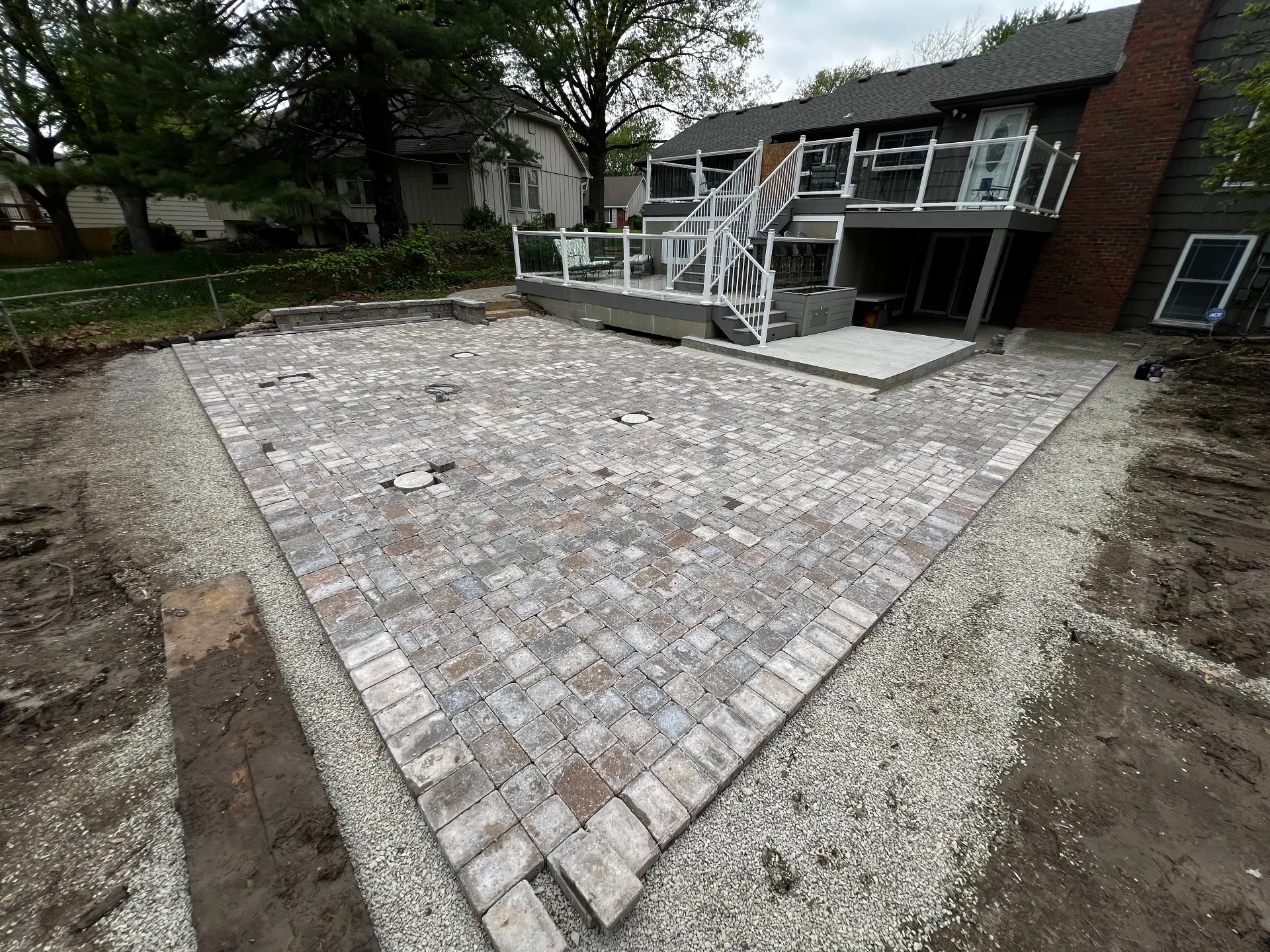
If you're choosing a surface for a patio, walkway, or driveway in Kansas City, you're likely comparing pavers vs. concrete. We're confidently pro-paver—modular pavers look better longer, won't leave you stuck with cracks, and are simple to repair. We don't install concrete in-house, but when a project truly calls for it, we coordinate with trusted, licensed concrete subcontractors to deliver a seamless result.
Quick verdict
Choose pavers for long-term appearance, easy repairs, design flexibility, and resilience through KC's freeze-thaw cycles and clay soils.
Use concrete where a continuous monolithic slab is structurally necessary (e.g., dumpster pads, footings) or when a specific spec requires it—we can coordinate it, then tie your concrete to adjacent paver areas cleanly.
Pavers vs. Concrete (Side-by-Side)
| Factor | Pavers | Concrete Slab |
|---|---|---|
| Cracking | Joints absorb movement; individual units move without slab cracks. | Slabs inevitably crack over time; joints only control where. |
| Repairs | Swap a few units, re-level, re-sand; finishes match. | Patches rarely match; often requires saw-cut and replacement of large sections. |
| Freeze-Thaw | Flexible system handles heave/settlement better. | Rigid slab; movement = cracks and spalling. |
| Drainage | Sand-set pavers drain through joints; permeable builds can infiltrate stormwater. | Non-permeable; relies on slope and drains—puddles if wrong. |
| Design | Patterns, borders, colors, curves, inlays. | Limited patterns; stamped finishes help but are one surface. |
| Utility Access | Lift and reset for repairs or new lines. | Saw-cut, demo, patch (visible). |
| Lifecycle Cost | Low—spot repairs extend life indefinitely. | Higher—crack repair/replacement cycles. |
| Initial Cost | Similar to quality stamped concrete; more than broom-finish. | Broom finish often lowest upfront. |
Cracking
Joints absorb movement; individual units move without slab cracks.
Slabs inevitably crack over time; joints only control where.
Repairs
Swap a few units, re-level, re-sand; finishes match.
Patches rarely match; often requires saw-cut and replacement of large sections.
Freeze-Thaw
Flexible system handles heave/settlement better.
Rigid slab; movement = cracks and spalling.
Drainage
Sand-set pavers drain through joints; permeable builds can infiltrate stormwater.
Non-permeable; relies on slope and drains—puddles if wrong.
Design
Patterns, borders, colors, curves, inlays.
Limited patterns; stamped finishes help but are one surface.
Utility Access
Lift and reset for repairs or new lines.
Saw-cut, demo, patch (visible).
Lifecycle Cost
Low—spot repairs extend life indefinitely.
Higher—crack repair/replacement cycles.
Initial Cost
Similar to quality stamped concrete; more than broom-finish.
Broom finish often lowest upfront.
Why concrete cracks (and why it's tough to "fix" cleanly)
Concrete is a single rigid slab. As soils move, temperatures swing, and loads change, cracks happen—even with control joints and rebar. Repairs are usually visible (color/texture mismatch) and can create a patchwork look. Resurfacing or overlays can help temporarily, but they still rely on the original slab's condition and movement.
Why pavers win in KC conditions
Pavers are a modular, flexible system installed over a compacted base. Joints let units move microscopically with the seasons, so you don't see slab-style cracking. If a corner settles or a utility needs service, we lift, correct the base, and relay the same pavers—often in a single visit—with no visible patch.
Permeable vs. Non-Permeable Paver Systems
Permeable means "allowing water to pass through." In hardscaping, permeable paver systems are designed with wider joints and an open-graded base that lets stormwater infiltrate into the ground rather than running off the surface.
Permeable Pavers (open-graded base + larger joint openings)
Best for: Driveways, parking courts, patios with puddling, codes with stormwater requirements, tree-friendly designs.
- Manages stormwater on-site (less runoff, fewer puddles/ice spots).
- Reduces load on drains; can help meet municipal stormwater goals.
- Supports healthy trees and soils by letting water/air move.
Maintenance: Periodic sweeping/vacuuming to keep joints open; occasional top-off of joint stone.
Good to know: Works even in clay soils when we include underdrains or storage layers to control where water goes.
Non-Permeable Pavers (traditional sand-set over dense-graded base)
Best for: Most patios, walks, pool decks, and driveways where surface drainage is already well managed.
- Classic look and feel; easy spot-repairs.
- Excellent freeze-thaw performance.
- Can pair with drains, swales, and French drains to move water where you want it.
Maintenance: Sweep as needed; refresh polymeric sand every few years; re-level localized areas if settlement occurs.
Our KC-Proven Install Standards (what makes them last)
- Site walk & drainage plan – Grade to protect structures and move water to safe outlets.
- Excavation & base – Correct depth for use (walk vs. drive), geotextile where needed, and heavy compaction in lifts.
- Edge restraints – Concealed edging or concrete curbs that lock the field in place.
- Bedding layer – Screeded setting bed; consistent thickness.
- Lay pattern & borders – Soldier/contrast borders, herringbone for drive loads, clean cuts at edges.
- Joint stabilization – Polymeric sand (or stone for permeable), compacted and activated properly.
- Finish – Final compaction, wash-down, punchlist, and a simple care plan.
Where concrete still makes sense (and how we handle it)
Some details are best as concrete: dumpster pads, structural footings, machine slabs, monolithic stairs. When your project needs that, we'll manage qualified subs and integrate concrete cleanly with adjacent pavers, drains, and walls—one contract, one point of accountability.
Cost & Value
- Upfront: Quality pavers typically price near stamped concrete and above broom-finished concrete.
- Lifetime: Pavers usually win—no slab-wide tear-outs, quick spot repairs, and enduring curb appeal that supports property value.
Design ideas that sell the look
- Borders & inlays: Contrast banding at edges and thresholds.
- Patterns: 45° herringbone for driveways, running bond for long walks, parquet squares for courts and plazas.
- Lighting: Recessed step lights, under-cap wall lighting, path lights integrated into beds.
- Drainage: Permeable bands or trench drains where water concentrates.
First-Year Care (simple & effective)
- Sweep & rinse quarterly.
- Top-off polymeric sand if joints open after the first winter.
- Spot re-level if a small area settles (we handle this quickly).
- Sealing is optional for color enhancement or stain resistance—ask us what fits your use.
FAQs
Will pavers shift or become uneven?
Not with a proper base, edging, and compaction. If settlement occurs (utilities, soils), we can lift and reset the small area.
Do weeds grow between pavers?
With polymeric sand and routine sweeping, weeds are minimal. Weeds that do appear are superficial and easy to remove.
Are pavers strong enough for driveways and commercial use?
Yes—pavers are designed for vehicular loads when installed over the right base and pattern (we often use herringbone for drive courts).
Do you install concrete?
We don't pour concrete in-house. When concrete is the right solution for a detail, we coordinate trusted subs and integrate everything under our design-build scope.
What about winter freeze-thaw?
That's where pavers shine. The flexible system handles movement without slab-style cracking.
Ready to plan your hardscape?
Let's design a paver system that looks incredible, manages water, and stays repairable for life.